The publisher onboarding playbook just got rewritten
If you’re running business development or partner operations at an SSP or ad network, you’ve probably noticed two seismic shifts happening at once: privacy regulations are killing third-party tracking, and the programmatic landscape is more fragmented than ever.
Most BD teams are still onboarding publishers the old way—chasing volume, running quick ads.txt checks, and hoping for the best. But the buyers your SSP serves are getting pickier. They want privacy-compliant inventory, contextual signals that actually work, and supply paths that don’t route through six resellers before hitting a bid request.
That means your publisher vetting process needs an upgrade. Here’s how to find, evaluate, and prioritize the right supply partners when the rules of the game have changed.
Privacy compliance is now table stakes
The first article’s thesis is correct: privacy regulations like GDPR and CCPA aren’t just legal boxes to tick—they’re reshaping which publishers can deliver value. Third-party cookies are gone or going. Buyers are pivoting hard to contextual targeting and first-party audience data.
For SSPs, this creates a clear filter: publishers who’ve adapted to privacy-first monetization are worth more than those still clinging to tracking pixels.
When you’re evaluating a new publisher, ask:
- Are they collecting consented first-party data (email sign-ups, preference centers, loyalty programs)?
- Do they offer strong contextual signals—actual page-level topics, not just domain categories?
- Are they transparent about what data they pass in bid requests?
You can’t rely on a publisher’s marketing deck to answer these questions. You need to see their ad stack in action. Tools that crawl sites and log which tags fire—and in what order—give you the ground truth. If a publisher is still loading dozens of third-party trackers in the EU, that’s a red flag before you waste time on integration.
Programmatic flexibility beats static deals (but not always)
The second article—an interview with an agency director at Novus Media—offers a critical insight: programmatic buying is winning because it’s faster to optimize, even when it sacrifices guaranteed placements.
Paul DeJarnatt’s team prefers programmatic CTV deals over direct IO buys because they can “shift dollars and react to the marketplace way faster.” The trade-off? You lose certainty about exactly which show or timeslot your ad runs in.
For SSPs, this is a strategic signal. Your pitch to publishers shouldn’t be “we’ll sell every impression at a premium.” It should be “we’ll give buyers flexible access to your inventory, and that flexibility drives more consistent fill and better performance.”
That said, DeJarnatt also acknowledges that fixed placements within programmatic environments have value—especially when advertisers need proof that their ads ran. Paramount and others are experimenting with this hybrid model, and it’s worth supporting if your publishers have premium, brand-safe content that justifies it.
The takeaway: onboard publishers who can offer both scale and optionality. A publisher with 10 million uniques and zero programmatic infrastructure is harder to monetize than one with 2 million uniques and clean header bidding already live.
Use data to shortlist, not to spam
Here’s where most SSP BD teams go wrong: they scrape a list of domains, fire off 500 templated emails, and wonder why response rates are 2%.
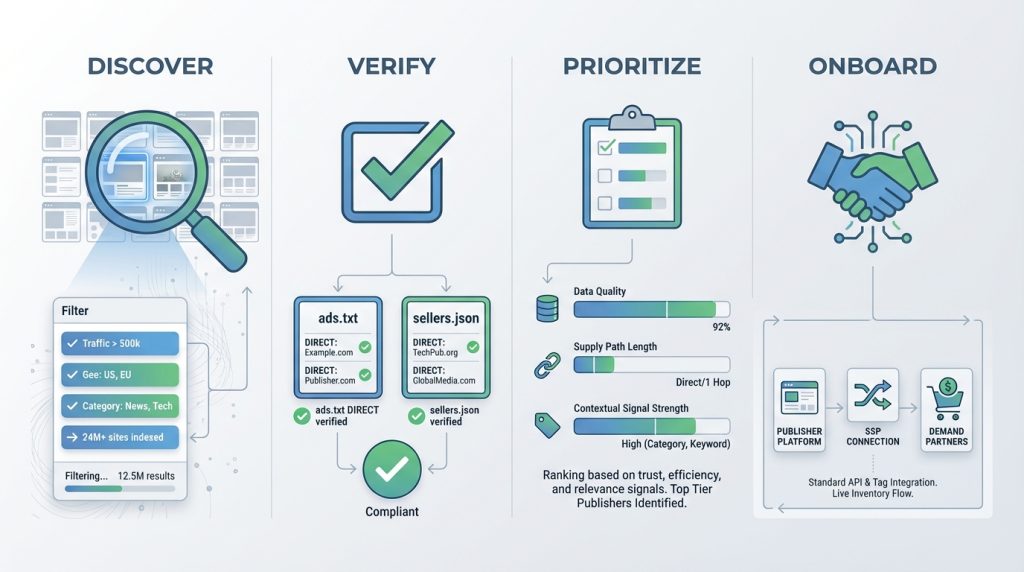
The smarter play is to build a qualified shortlist before you make first contact. That means using data to answer:
1. Is this publisher already monetizing programmatically? (Check if they’re running header bidding, Prebid wrappers, or specific SSP tags.)
2. What’s their ads.txt hygiene? Are they listing dozens of resellers, or a tight, curated set of direct relationships?
3. Do they align with sellers.json transparency standards? Can you see a clear chain of custody?
4. What’s their traffic composition? (Mobile web vs desktop, geo split, referral sources.)
Red Volcano’s Publisher Sales platform, for instance, indexes 24 million+ sites and logs which ad tech vendors are live on each. You can filter by “sites running Prebid but not yet integrated with SSP X” or “publishers with DIRECT ads.txt entries for fewer than 5 SSPs.” That level of targeting turns outreach from a numbers game into a precision operation.
You can also surface competitive intelligence: which SSPs a publisher is already working with, and whether those relationships are direct or resold. If a publisher has eight RESELLER entries and zero DIRECT ones, that tells you they’re either undermonetized or working through networks—and there’s an opening for a direct conversation.
Prioritize signal quality over raw scale
In a fragmented, privacy-first world, not all impressions are equal. Buyers are tired of bid requests with no useful context, no consent signal, and a 12-hop supply chain.
Your job as an SSP BD lead is to prioritize publishers who make your bid requests better. That means:
- Publishers with rich first-party data segments they’re willing to pass (consented categories, declared interests, zero-party survey responses).
- Publishers with strong editorial context—real article text, video metadata, structured content that powers semantic targeting.
- Publishers who keep their supply path short. Every reseller hop adds latency and muddies attribution. DIRECT sellers.json entries are a quality signal.
If you’re choosing between onboarding 50 long-tail blogs or 5 mid-tier publishers with clean data and transparent supply chains, go with the five. Your buyers will thank you, and your win rates will reflect it.
Stop guessing, start measuring
The old publisher onboarding model—gut feel, vanity metrics, and “let’s try it and see”—doesn’t work anymore. Privacy regulations and programmatic fragmentation have raised the bar.
The new model is data-driven qualification, compliance verification, and supply path transparency. You need to see what’s actually happening on a publisher’s site, not just what they claim in a pitch deck.
If you’re still building shortlists from Similarweb and crossing your fingers, you’re leaving money on the table—and onboarding partners who’ll hurt your SSP’s reputation with buyers.
Want to see how Publisher Sales helps SSPs and ad networks find, vet, and prioritize the right publishers? Let’s talk. We’ll show you exactly which sites in your target verticals are already monetizing programmatically, who they’re working with, and where the gaps are.